Why is my grass turning yellow?
Read the pattern first. An even, pale lawn is usually short of nitrogen. Yellow on the newest leaves points to iron. Patches, stripes and yellow after mowing each have their own cause. Pick what you see.
Test before you buy: water about two handfuls of a nitrogen fertilizer with no iron in it into a 10 by 10 foot square. If that square greens up in about a week, the lawn was short of nitrogen (University of Arizona). Then feed at the right time for your grass.
Test: dissolve 1 teaspoon of iron sulfate in half a gallon of water and spray a 15 by 15 foot square. Do not mow or water for 24 hours. In warm weather the yellow should fade within a few days if iron is the cause (University of Arizona). Keep iron sulfate off concrete: it stains.
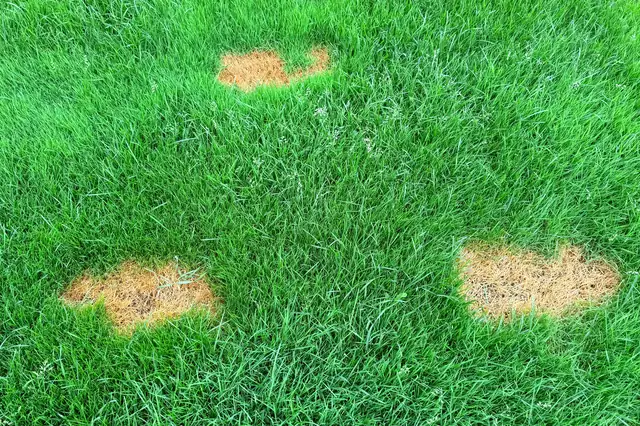
Each has its own page: grubs, dog urine spots, chinch bugs and brown patch.
Water scorched strips well, calibrate the spreader before the next feed, and work out the right amount with the fertilizer calculator. Reseed strips that have died.
Sharpen or replace the blade at least once a year (University of Maryland), raise the deck, and take no more than a third of the leaf at a time. Mowing heights for every grass.
Water only when the soil has dried: soak it about 6 inches deep, then wait (University of Nebraska). Fix low spots and compacted soil. See when and how much to water.
Hold the first feed until the lawn has fully greened and the soil is warm. Check your soil temperature and see when to fertilize.
Find the cause from the pattern
Yellow grass is a symptom with a dozen causes, and the fix for one can make another worse. The pattern on the lawn narrows it down quickly. This table brings together the diagnosis guides of University of Maryland, University of California and other extension services.
| What you see | Likely cause | Quick check | What to do | Source |
|---|---|---|---|---|
| Whole lawn light green, older lower leaves yellow | Short of nitrogen | Nitrogen strip test: greener in about a week | Feed at the right time for your grass | U. of Arizona, U. of Maryland |
| Newest leaves yellow from the tip, often patchy, often alkaline soil | Short of iron (iron chlorosis) | Iron spray test: greener within days | Spray iron sulfate on the leaves; water deeply but less often; no extra nitrogen | U. of Arizona, U. of Nebraska, UF/IFAS |
| Paler, bluish or straw-colored in dry weather; footprints stay | Drought stress | Footprints still show after a few minutes | Water deeply. Turf usually recovers with rain or watering | U. of Maryland |
| Yellow where water stands or the soil stays soggy | Waterlogged roots | Soil squelches underfoot; puddles after rain | Water less often, fix drainage, core aerate | UGA, NC State, U. of Nebraska |
| Grayish cast after mowing; ragged, torn tips | Dull mower blade | Look closely at a cut leaf: torn, not clean | Sharpen or replace the blade | UC IPM, U. of Maryland |
| Yellow or brown on bumps and slopes after mowing | Scalping | Stems show where the mower dipped | Raise the deck; level the high spots | UC IPM, U. of Maryland |
| Streaks, bands or odd shapes | Fertilizer or weed killer spread unevenly | The shape follows a spreader or sprayer path | Water in; calibrate the spreader; reseed dead strips | U. of Maryland |
| Bleached spots ringed by dark green grass | Dog urine | Where the dog goes | Water the spot; reseed the dead center | U. of Maryland |
| A large yellow area beside a pool | Chlorine from splashing or leaks | Right next to the pool | Water heavily to wash it out; replant if it died | U. of Maryland |
| Yellow or reddish cast; orange dust on shoes | Rust (a fungus) | Wipe the grass with a white cloth | Keep the lawn fed; water in the morning, not the evening | U. of Maryland |
| Yellow patches in St. Augustine that turn brown and spread; short, dark roots | Take-all root rot | Dig up a runner and look at the roots | Better care, not chemicals; ask your extension office | Alabama Extension, UF/IFAS |
Two weeds also read as yellow from a distance. Shiny, yellow-green blades that outgrow the lawn are usually nutsedge. Pale tufts with whitish seedheads in spring are annual bluegrass.
Nitrogen or iron? Look at which leaves are yellow
These are the two causes people mix up most, and the wrong guess costs a season. University of Arizona explains the difference by how each nutrient behaves inside the plant. Nitrogen moves, so the plant takes it from old leaves to feed new ones. Iron stays put, so the new leaves show the shortage first.
The whole lawn tells you something too. LSU AgCenter puts it simply: a lawn short of iron is definitely yellow, often in blotches, while a lawn short of nitrogen is a pale, light green across most of the lawn.
Test it in one afternoon
University of Arizona describes two small tests. Do them side by side on similar grass:
- The nitrogen square. Spread about two handfuls of a nitrogen fertilizer, such as ammonium sulfate, over a 10 by 10 foot square and water it in. Use a product with no iron, or the test tells you nothing.
- The iron square. Dissolve 1 teaspoon of iron sulfate powder in half a gallon of water and spray it over a 15 by 15 foot square. Leave it on the leaves for 24 hours before you mow or water. Do not use ferrous ammonium sulfate: it contains nitrogen.
- Read the result. If the iron square greens within a few days in warm weather, iron is the cause. If the nitrogen square greens in about a week, nitrogen is.
If it is iron
- Spray it on the leaves. UF/IFAS found that granular iron sulfate is mostly locked up by the soil within an hour, and only iron sulfate sprayed on the foliage gave a response in its trials.
- Expect to repeat it. The green lasts up to about four weeks according to UF/IFAS, and about three weeks in Arizona's experience, because the soil ties the iron up again.
- Do not overdo it. UF/IFAS warns that heavy rates can burn the leaves or turn them black for a while, and that iron sulfate leaves rust-brown stains on wet concrete that are hard to remove.
- Hold back the nitrogen. More growth needs more iron. University of Nebraska says nitrogen compounds the problem, and Arizona says it can turn the leaves white in a severe case.
- Water deeply, then let it dry. Nebraska links the summer yellowing of Kentucky bluegrass to high soil pH plus roots that work poorly in hot soil kept constantly wet. Soak to about 6 inches, then wait. Core aerate in September if it has not been done for a few years.
- Be patient. In Kentucky bluegrass it tends to appear in summer and fade by fall or the next spring, Nebraska notes.
Soil pH works both ways. Iron gets locked up as pH rises, which is why it shows on alkaline soils (University of Arizona). Very acidic soil also blocks nutrients: University of Maryland advises testing and liming to keep the pH near 6.0 or higher. A soil test settles it. See when to lime.
If it is nitrogen
Feed the lawn in its growing season, not in its rest. Cool-season grass is fed mainly in fall, warm-season grass from late spring into summer. The fertilizer timing page gives the window for your grass and ZIP code, and the fertilizer calculator turns a bag into the right amount for your lawn. For a product, see the best lawn fertilizer guide, and what the numbers on the bag mean.
When yellow is normal
- Warm-season grass in winter. Bermuda, zoysia, St. Augustine and centipede go dormant and turn tan or brown after frost. They green up again in spring.
- Cool-season grass in a dry summer. Unwatered tall fescue and bluegrass go pale, then straw-colored. University of Maryland notes drought-stressed turf usually recovers once it gets enough rain or water.
- Patchy green-up in spring. Warm-season lawns often look yellow while they wake. UF/IFAS says this usually clears within a few weeks as the soil warms.
Questions people ask
Why is my grass turning yellow after fertilizing?
Usually one of two reasons. Too much fertilizer in one place damages the roots, and it shows as streaks or patches that follow the spreader path (University of Maryland). Or the lawn was short of iron: the extra growth from nitrogen raises the need for iron, so the new leaves yellow more (University of Nebraska, UF/IFAS).
Will yellow grass turn green again?
In most cases, once the cause is fixed. Drought-stressed turf usually recovers with rain or watering (University of Maryland). Iron yellowing in Kentucky bluegrass often fades by fall (University of Nebraska), and spring yellowing in warm-season grass within a few weeks (UF/IFAS). Grass killed by grubs, fertilizer burn or root rot needs seed or sod.
Does iron make grass greener?
Often, and fast, when the grass is short of iron: within days. Sprayed iron sulfate keeps it greener for up to about four weeks (UF/IFAS). Iron cannot fix a shortage of nitrogen, so a lawn that is short of nitrogen stays pale.
Can overwatering turn grass yellow?
Yes. Soil that stays saturated runs out of air, the roots cannot get oxygen and the leaves turn yellow (UGA, NC State). Water deeply and only when the soil has dried, and fix low spots where water stands.
Why is my grass yellow after mowing?
Look at the cut tips. Torn, ragged tips that go gray and then yellow mean a dull blade (UC IPM). Yellow or brown on bumps and slopes means the mower cut too low and scalped it. Sharpen the blade and raise the deck.
Why is my St. Augustine grass turning yellow?
In spring, usually a short-lived iron shortage while the roots catch up (UF/IFAS). Yellow patches that turn brown and keep spreading, with short dark roots, point to take-all root rot (Alabama Extension). Yellowing in the hottest, sunniest spots in summer calls for a chinch bug check.
Sources
- University of Arizona, Nitrogen and Iron Deficiencies in turfgrass
- University of Maryland Extension, Diagnose home lawn problems
- University of Maryland Extension, Nutrient deficiency in lawns
- University of Maryland Extension, Dull mower blade and mower injury
- UF/IFAS Extension, Iron for Florida Turfgrasses
- University of Nebraska-Lincoln Extension, Yellowing of Kentucky bluegrass and oak/maple
- LSU AgCenter, Ironing Your Turfgrass
- University of California IPM, Dull mower blades
- University of California IPM, Scalping
- University of Georgia Extension, Water-logged lawns
- NC State Extension, Caldwell County, Why do I have brown patches in my yard?
- Alabama Cooperative Extension System, Take-all root rot on St. Augustinegrass