Soil temperature today, by ZIP code
The reading at 2 inches deep for your location, the last 7 days, a forecast, and what it means for your lawn.
Soil temperature map: every state right now
Soil at 2 inches deep across the country, in blocks about 110 miles across. For your own lawn, use your ZIP code above.
ColdWaking up or coolingPre-emergent rangeSeed and crabgrassWarm-season growthHot
You get its soil temperature, what that means for a lawn, and a link to its cities.
All 50 states, warmest first
One reading for each state, taken at the state capital.
Loading the readings…
City readings and spring dates, state by state
Alabama · Alaska · Arizona · Arkansas · California · Colorado · Connecticut · Delaware · Florida · Georgia · Hawaii · Idaho · Illinois · Indiana · Iowa · Kansas · Kentucky · Louisiana · Maine · Maryland · Massachusetts · Michigan · Minnesota · Mississippi · Missouri · Montana · Nebraska · Nevada · New Hampshire · New Jersey · New Mexico · New York · North Carolina · North Dakota · Ohio · Oklahoma · Oregon · Pennsylvania · Rhode Island · South Carolina · South Dakota · Tennessee · Texas · Utah · Vermont · Virginia · Washington · West Virginia · Wisconsin · Wyoming
What the numbers mean for a lawn
| Soil at 2 inches | Stage | What to do |
|---|---|---|
| Below 40 °F | Cold | Lawn grasses are dormant or barely growing. Nothing to apply. |
| 40 to 50 °F | Waking up | Cool-season roots are growing. Get pre-emergent and the spreader ready. |
| 50 to 55 °F | Pre-emergent window | The target range for crabgrass preventer. Apply and water it in before the soil settles above 55 °F. |
| 55 to 65 °F | Crabgrass germinating | Crabgrass starts once soil holds 55 °F for four or five days. Cool-season grass seed also sprouts well here. |
| 65 to 80 °F | Warm-season growth | Bermuda, zoysia and centipede grow and can be seeded. Too warm for most pre-emergent to help. |
| 80 and up °F | Hot | Cool-season lawns are under heat stress. Water deeply, mow high, and hold fertilizer. |
50 to 55 °F: put down crabgrass preventer
Michigan State University's turf team targets soil at 50 to 55 °F for pre-emergent, and the University of Wisconsin's turf program gives the same range. The product has to be down and watered in before crabgrass seed starts to grow. See your pre-emergent window.
55 °F held for several days: crabgrass starts
UMass Extension puts the start of germination at 55 °F at the soil surface for four or five consecutive days. One warm afternoon does not count. Look at the daily averages in the list above, not the peak.
65 °F and warmer: warm-season grasses
Bermuda, zoysia and centipede grow and spread in warm soil, and their seed needs it to sprout. North Carolina's planting table has bermuda going in from April to July.
Falling through 70 °F in late summer: annual bluegrass
The winter weed annual bluegrass germinates once soil cools below about 70 °F, according to University of Georgia and Purdue. That makes late summer the time for a fall pre-emergent, and also the start of the best seeding weeks for cool-season grass. You can do one or the other on the same ground, not both.
How to measure it yourself
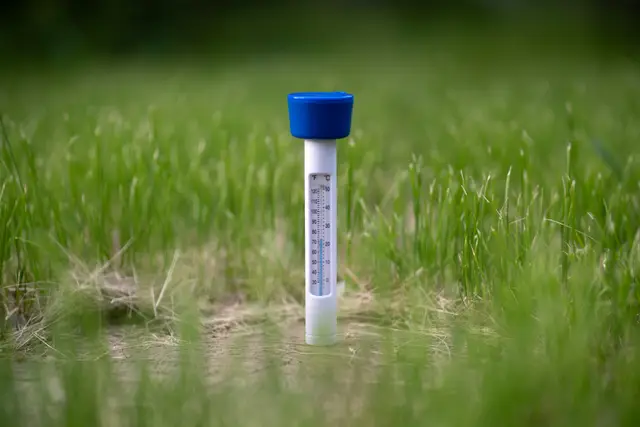
- Use a probe thermometer. A soil or kitchen probe thermometer works. Push it 2 inches into the lawn, not a bare flower bed.
- Measure in the early morning. Around 7 to 8 a.m. gives the day's low. Afternoon readings run 10 to 15 °F higher on sunny spring days.
- Check a few spots. Take one reading in sun and one in shade. South-facing slopes and soil next to pavement warm first, and that is where crabgrass shows up first.
- Watch several days. Germination follows the average over days, so write the readings down or use the daily list on this page.
Questions people ask
What is the soil temperature today?
Enter your ZIP code at the top of this page. You get the current reading at 2 inches deep, readings at the surface and at 7 inches, the last 7 days and a forecast. The state map shows the reading at each state capital, updated every hour.
What soil temperature does crabgrass germinate at?
UMass Extension says crabgrass begins to germinate when the soil surface reaches 55 °F for four or five days in a row. Purdue cites research finding that it starts when daily average soil temperature at 1 inch reaches 57 to 64 °F, with heavy germination once soil reaches 73 °F or more. That is why pre-emergent goes down earlier, at 50 to 55 °F.
How deep should I measure soil temperature for a lawn?
About 2 inches. The pre-emergent target from Michigan State and Wisconsin is given at a 2-inch depth, and grass seed sits in the top inch. This page reports 2 inches as the main reading.
What time of day should I take a soil temperature?
Early morning, around 7 to 8 a.m., is the day's low point. A Michigan State bulletin notes soil can read 10 to 15 °F higher by mid-afternoon on a sunny, fairly dry day in late April and May, so one afternoon reading of 59 °F does not mean crabgrass will germinate. The daily average is what counts.
Is soil temperature the same as air temperature?
No. Soil warms and cools more slowly than air and holds heat overnight. In spring, soil lags behind a run of warm days; in fall, it stays warm after the air turns cold.
How accurate are these soil temperatures?
They are modeled values for your location from a weather model, not a probe in your lawn. Shade, mulch, slope, wet soil and thick turf all shift the real number by a few degrees. For a decision that matters, confirm with a soil thermometer pushed 2 inches into your own lawn.
Next on your lawn
Sources
- Michigan State University Extension, Timing crabgrass preemergence applications in spring
- University of Wisconsin-Madison Turfgrass Science, Early season creates uncertainty
- UMass Extension, Biology and Management of Crabgrass
- Purdue Turfgrass Science, When Will Crabgrass Germinate?
- Michigan State University Libraries, turfgrass archive: Soil Temperature and Crabgrass (J. Lefton, 1991)
- North Carolina Department of Agriculture, Soil Fertility Note 5: Warm-season grasses