Topsoil calculator
Cubic yards, bags and weight for top dressing, leveling or a new lawn. Enter the area and pick the job.
Front and back lawn? Work out one here and type the other one in.
Not sure? Pace it out: one long stride is about 3 feet. Leave out the house, drive and beds.
A quarter inch is the usual pass. Half an inch is the most to put down at once, or the grass is smothered.
Show the working
Topsoil for every 1,000 square feet
Multiply any row by your lawn size in thousands of square feet. The formula behind it: square feet × depth in inches ÷ 324 = cubic yards.
| Depth | Cubic yards | Cubic feet | 0.75 cu ft bags | One yard covers |
|---|---|---|---|---|
| 1/8 in | 0.39 | 10.4 | 14 | 2,592 sq ft |
| 1/4 in | 0.77 | 20.8 | 28 | 1,296 sq ft |
| 1/2 in | 1.54 | 41.7 | 56 | 648 sq ft |
| 1 in | 3.09 | 83.3 | 112 | 324 sq ft |
| 2 in | 6.17 | 166.7 | 223 | 162 sq ft |
| 4 in | 12.35 | 333.3 | 445 | 81 sq ft |
| 6 in | 18.52 | 500.0 | 667 | 54 sq ft |
Which depth for which job
Top dressing an existing lawn: 1/4 inch
A quarter inch is the standard pass. You should still see grass blades standing through the soil when you finish. Half an inch is the most to put down in one go; deeper than that and the grass underneath is smothered. If the lawn needs more, wait until the grass has grown through and do a second pass.
Leveling low spots: 1/2 inch at a time
Measure only the dips, not the whole lawn. Fill half an inch, let the grass grow through, then fill again. For a hollow deeper than about 2 inches it is quicker to lift the turf, fill underneath and lay the turf back.
Covering seed after overseeding: 1/4 inch
Henrico County Extension's worksheet uses a quarter-inch cover over overseeded turf. It keeps seed moist and hides it from birds. After you have the soil amount, the grass seed calculator gives the seed.
A new lawn: 4 to 6 inches
Penn State Extension's lawn establishment guide says a minimum of 4 to 6 inches of good-quality topsoil, firmed or settled, is typically needed for good turf. Grade it so the ground falls gently away from the house: Penn State gives a 1 to 4 percent slope, which is a 1 to 4 foot drop over 100 feet.
Bulk or bags?
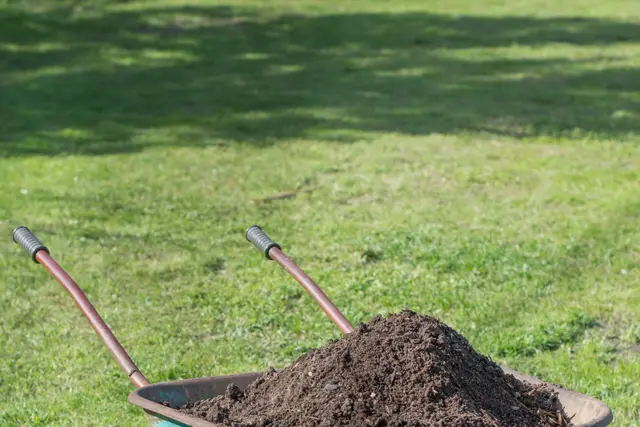
Under one cubic yard, bags are usually easier: no delivery fee and no pile on the drive. From about one cubic yard up, bulk is far cheaper per cubic foot. One cubic yard equals 36 bags of 0.75 cubic feet, which is a lot of lifting. Suppliers sell bulk soil by the half yard or yard, so the calculator rounds your order up to the next half yard.
Worked example. A 60 × 40 ft back lawn is 2,400 sq ft. Top dressing at 1/4 inch: 2,400 × 0.25 ÷ 324 = 1.85 cubic yards. Order 2 cubic yards in bulk, or buy 67 bags of 0.75 cubic feet.
Questions people ask
How many bags of topsoil are in a cubic yard?
A cubic yard is 27 cubic feet. That is 36 bags of 0.75 cubic feet, 27 bags of 1 cubic foot, or 18 bags of 1.5 cubic feet. Bag sizes vary by brand, so read the volume printed on the bag, not the weight.
How much area does one cubic yard of topsoil cover?
Divide 324 by the depth in inches. One cubic yard covers 1,296 square feet at a quarter inch, 648 at half an inch, 324 at 1 inch, 81 at 4 inches and 54 at 6 inches.
How much does a cubic yard of topsoil weigh?
Roughly 1.1 to 1.3 tons (2,200 to 2,600 lb), and more when it is wet. Suppliers weigh their own material, so ask before you plan a pickup. Many half-ton pickups are rated for less than one cubic yard.
How deep should topsoil be for a new lawn?
Penn State Extension gives 4 to 6 inches of good-quality topsoil as the usual minimum for good turf, measured after it has been firmed or has settled. Fresh soil settles, so order for the settled depth plus a little extra.
How much topsoil do I need to top dress a lawn?
For a quarter-inch pass, 0.77 cubic yards for every 1,000 square feet. A 5,000 square foot lawn needs about 3.9 cubic yards. Keep a single pass to half an inch at most so the grass is not buried.
Is topsoil sold by the yard or by the ton?
Both. Most landscape suppliers sell by the cubic yard; some quarries sell by the ton. To compare, multiply cubic yards by about 1.1 to 1.3 to get tons, and ask the supplier for their own figure, because wet soil weighs more.
Should I add extra?
Add about 10% when the ground is uneven, when you are filling low spots, or when the soil is fluffy and freshly screened. Tick "Add 10% extra" and the calculator does it for you.
Next on your lawn
Sources
- Penn State Extension, Lawn Establishment
- Henrico County Extension (Virginia Cooperative Extension), How to Calculate Amounts of Peat Moss, Compost and Topsoil
- James B. Beard, Turfgrass: Science and Culture: 0.77 cubic yards per 1,000 sq ft for a 1/4 inch top dressing, which matches the formula above