How to get rid of grubs in your lawn
Count before you treat. A few grubs are normal. About ten in a square foot is the point where treatment pays, and the right product depends on the month.
Cut three sides of a 1 ft square with a spade, peel the turf back, and count the grubs in the top 2 to 3 inches. Check a few spots.
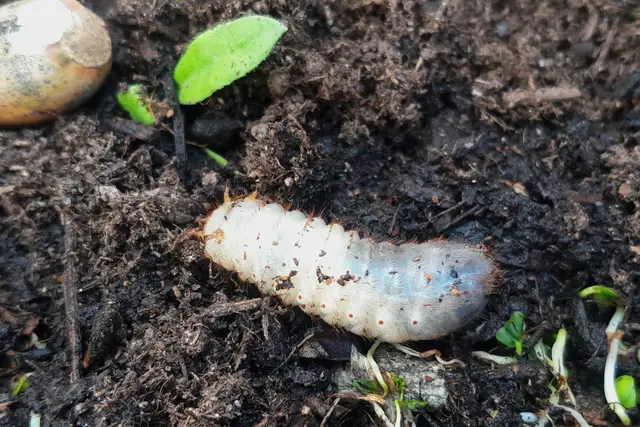
Grubs over an inch long are usually May or June beetles, which do damage in smaller numbers.
How to check for grubs
This is University of New Hampshire Extension's method.
- Cut a one-foot square. Use a spade or lawn edger where the grass is browning, at the edge between damaged and healthy turf.
- Peel it back. If grubs have eaten the roots, the turf lifts easily.
- Count. Sift the soil and count every white, C-shaped grub.
- Repeat in other spots. One square does not speak for the whole lawn.
The numbers that matter
| Grub | Treat at | Source |
|---|---|---|
| Japanese beetle | 8 to 10 per sq ft | Clemson, Nebraska |
| Masked chafer | 8 to 10 per sq ft | Clemson, Nebraska |
| May and June beetles (large) | 3 to 5 per sq ft | Clemson, Nebraska |
| Any species, simple rule | 10 or more per sq ft | New Hampshire |
Below these numbers a healthy lawn outgrows the feeding. Clemson notes that stressed turf shows damage at lower counts, and Wisconsin points out that most white grubs in the Midwest are harmless scavengers that break down organic matter.
Preventive or curative: it depends on the month
| Approach | When | Active ingredients | Use it when |
|---|---|---|---|
| Preventive | Mid to late June | Imidacloprid, chlorantraniliprole | The lawn had grub damage last year |
| Curative | August and September | Trichlorfon, carbaryl | You count damaging numbers now |
Preventive products have to be in the soil before the young grubs start feeding; Nebraska says their effect is already reduced by late July. No product kills every grub: Nebraska Extension puts the usual result at 75 to 90 percent. Whichever you use, water it in as the label directs so it reaches the grubs, and keep it off flowering plants that bees visit.
Low-risk lawns. Nebraska Extension says new lawns, low-maintenance lawns and turf-type tall fescue lawns have few grub problems and seldom need preventive treatment.
Repair the damage
Rake out the dead turf, loosen the top of the soil, and reseed in late summer or early fall. The grass seed calculator gives the seed, and the topsoil calculator the soil to cover it. If animals are digging, they stop when the grubs are gone. Moles are a separate matter: killing grubs does not get rid of moles.
Questions people ask
How many grubs per square foot is too many?
About 10. University of New Hampshire Extension calls 10 or more per square foot a serious infestation, and Nebraska and Clemson put the threshold at 8 to 10 for masked chafer and Japanese beetle grubs. The larger May and June beetle grubs do damage at 3 to 5. A few grubs are normal and need no treatment.
When should I apply grub control?
Preventive products go down in mid to late June, before eggs hatch, according to Nebraska Extension. If you find damaging numbers in August or September, that calls for a curative product instead. Early spring and late fall applications miss the stage the products work on.
What kills grubs right now?
Trichlorfon (sold as Dylox) or carbaryl (Sevin). UMass lists them as the curative choices, and Nebraska says they give the best control in August and September because they kill mature grubs better. Water them in as the label says.
What is the best preventive grub killer?
Imidacloprid or chlorantraniliprole. Nebraska Extension says both give excellent control when applied in mid to late June. Chlorantraniliprole is the active ingredient in Scotts GrubEx.
Does milky spore work?
University of Wisconsin-Madison Extension says recent university research has not found milky spore effective for white grub control.
How do I know the damage is grubs?
Tug the brown turf. Grubs eat the roots, so damaged grass lifts like a loose carpet, and you will find C-shaped white grubs in the top couple of inches of soil. Skunks, raccoons and birds tearing up the lawn are another sign. Brown grass that stays firmly rooted has another cause.
Will the lawn recover from grubs?
Lightly damaged turf recovers with water and feeding. Dead patches need reseeding or sod in early fall. Healthy lawns with deep roots tolerate more grubs than the thresholds suggest, as Cornell notes.
Next on your lawn
Sources
- University of New Hampshire Extension, grub questions and how to check a lawn
- Nebraska Extension, What Are Grubs?
- Nebraska Extension, Common Grub Control Questions
- UMass Extension, Current Insecticide Approaches for White Grub Control
- University of Wisconsin-Madison Extension, Grub Control in the Home Lawn (XHT1018)
- Clemson University, White Grubs
- Cornell University, White Grubs