When to apply pre-emergent
Enter your ZIP code. You get your crabgrass preventer window from local temperatures, where this year stands, and when it opened in each of the last five springs.
The short answer
Apply crabgrass pre-emergent when soil at 2 inches is 50 to 55 °F, which matches 250 to 500 growing degree days on Michigan State University's model. The date moves by weeks with latitude and from one year to the next. In Massachusetts, UMass Extension puts it in late April or early May; further south it comes much earlier. That is why a fixed date on the calendar misses.
Two checks that should agree
1. Growing degree days: 250 to 500
A growing degree day is a count of warmth. Each day adds its average air temperature minus 32 °F, and the count starts on February 15. Michigan State's crabgrass model puts the best application window at 250 to 500. Michigan State says to treat the models as guides: you do not have to apply on the first day the window opens.
2. Soil temperature: 50 to 55 °F
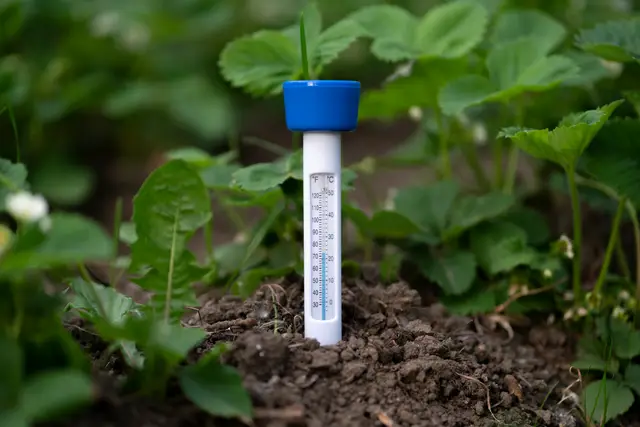
The University of Wisconsin's turf program says that if 2-inch soil temperatures are 50 to 55 °F while the model is between 250 and 500, things are on track. The tool above shows both for your ZIP code.
Why two checks
The air-temperature count can run ahead of the soil. Wisconsin describes a spring when warm air arrived so fast that there was still frost in the ground while the count shot up. If the two disagree, trust the soil.
Fall pre-emergent: a second window
Crabgrass is a summer weed. Annual bluegrass (Poa annua) is its winter twin: University of Georgia, Purdue and Mississippi State all say it germinates in late summer or early fall once soil temperatures fall below about 70 °F, and University of Tennessee notes germination then carries on for two to three months. A fall pre-emergent has to be down before the soil cools through 70 °F. Mississippi State's advice is that early is better than late.
Two cautions. Do not apply it where you plan to seed or overseed this fall: Texas A&M warns that pre-emergents can injure new or overseeded lawns. And it will not remove annual bluegrass that already lives in the lawn from year to year. Watch your soil temperature in late summer for the drop toward 70 °F.
How to apply it
- Measure the lawn. Rates are per 1,000 square feet. If you do not know your area, the fertilizer calculator has a quick area tool.
- Read the label rate. The label on the bag sets the amount and the spreader setting. Do not go over it.
- Spread evenly. Put down half walking one way and half walking across it, so there are no stripes or gaps for crabgrass to come through.
- Water it in. Follow the label: the barrier forms in the soil, not on the leaves.
- Write down the date. The label says how many weeks the barrier lasts and whether a second application is allowed.
Questions people ask
When should I apply pre-emergent?
When your soil is at 50 to 55 °F at 2 inches deep, or when 250 to 500 growing degree days (base 32 °F, counted from February 15) have built up. Enter your ZIP code above to see both for your location.
What soil temperature is too late for pre-emergent?
Once soil has held 55 °F for four or five days, crabgrass has started to germinate and most pre-emergent products cannot stop the seedlings already growing. Purdue cites research showing the bulk of germination comes later, so a late application still stops part of the crop.
I missed the window. What now?
Rutgers turfgrass specialists note that dithiopyr (sold as Dimension) can control crabgrass after it has sprouted, up to the stage before it sends out side shoots. Look for it on the label of a late-spring crabgrass preventer. After that, use a post-emergent crabgrass killer on young plants.
When do I apply pre-emergent in the fall?
Before your soil cools through about 70 °F in late summer or early fall. That is when annual bluegrass starts to germinate, according to University of Georgia, Purdue and Mississippi State extension publications. Skip it on any area you plan to seed.
Do I have to water in pre-emergent?
Yes. The product has to be washed off the grass and into the top of the soil to form its barrier. Michigan State describes applying early enough for the product to be put down and watered in before germination. Your label gives the amount of water and how soon.
Can I use the forsythia bloom as a signal?
Yes, as a back-up. UMass Extension says the best time is before or at full forsythia bloom, and Michigan State calls blooming forsythia a good indicator. Rutgers warns it can fail in years when a hard freeze damages the flowers.
Can I seed grass and apply pre-emergent at the same time?
Not with most products: they stop grass seed too. University of Tennessee Extension notes one exception, siduron (Tupersan), which can be applied before seeding fescues, Kentucky bluegrass, perennial ryegrass and zoysia. Otherwise pick one job for spring and do the other in fall.
Why did my window open so early?
The growing degree day model was built in Michigan, where winters are cold. Where winters are mild, the count passes 250 within days of February 15 because the soil never cooled down. In those places rely on the soil reading and your state extension service's calendar.
Next on your lawn
Sources
- Michigan State University, About GDD Tracker: counting starts February 15; crabgrass pre-emergence window 250 to 500, base 32 °F
- Michigan State University Extension, Timing crabgrass preemergence applications in spring
- University of Wisconsin-Madison Turfgrass Science, Early season creates uncertainty
- UMass Extension, Biology and Management of Crabgrass
- Purdue Turfgrass Science, When Will Crabgrass Germinate?
- Rutgers Turfgrass, Hurry up and wait... now go
- University of Tennessee Extension, Turfgrass Establishment: Seeding (W160-B)
- University of Georgia Extension, Annual Bluegrass Control in Residential Turfgrass (B 1394)
- Purdue Turfgrass Science, Annual bluegrass starting to succumb to summer stress in lawns
- Mississippi State University Extension, annual bluegrass control publication
- University of Tennessee Extension, Annual Bluegrass Control in Non-overseeded Bermudagrass (W203)
- Texas A&M AgriLife Extension, Preemergence Herbicide Guide