Grass seed calculator
Pounds of seed for your lawn, by grass type, for a new lawn or for overseeding. Rates come from university extension guides.
Front and back lawn? Work out one here and type the other one in.
Not sure? Pace it out: one long stride is about 3 feet. Leave out the house, drive and beds.
The grass type and mix are printed on the seed label.
Coating adds weight that is not seed, so the rate goes up: double for bermuda (University of Kentucky), 2 to 3 lb for zoysia (University of Missouri).
Show the working
Seeding rates by grass type
Pounds of seed for every 1,000 square feet. These are the rates the calculator uses.
| Grass | New lawn | Overseeding | Source |
|---|---|---|---|
| Tall fescue (turf-type) | 6 to 8 lb | 4 lb | Penn State, U. of Maryland |
| Kentucky bluegrass | 2 to 3 lb | 1.5 lb | Penn State, U. of Maryland |
| Perennial ryegrass (turf-type) | 4 to 5 lb | 2 to 2.5 lb * | Penn State, Nebraska |
| Fine fescue | 4 to 5 lb | 2.5 lb | Penn State, U. of Maryland |
| Kentucky bluegrass + perennial ryegrass mix | 3 to 4 lb | 1.5 to 2 lb * | Penn State, Nebraska |
| Bluegrass + fine fescue + ryegrass mix | 3 to 4 lb | 1.5 to 2 lb * | Penn State, Nebraska |
| Bermuda grass (common, hulled, uncoated) | 1 to 2 lb | not overseeded | North Carolina Department of Agriculture, U. of Kentucky Turfgrass Science |
| Zoysia grass (seeded types) | 1 to 2 lb | not overseeded | U. of Georgia, U. of Missouri |
| Buffalo grass (burs) | 1 to 2 lb | not overseeded | Nebraska |
| Centipede grass | 0.25 lb | not overseeded | U. of Florida IFAS |
| Bahia grass | 5 to 10 lb | not overseeded | U. of Florida IFAS |
* No overseeding rate is published for these, so the calculator uses Nebraska Extension's rule of up to half the new-lawn rate.
Rates differ a little between states. Purdue, for example, gives 1.5 to 2 lb for Kentucky bluegrass and 6 to 9 lb for tall fescue. If your state's extension service publishes its own table, use theirs.
St. Augustine grass is not on the list because it is not planted from seed. It goes in as sod, sprigs or plugs.
Why the rates are so different
Seed size. University of Tennessee Extension explains that small-seeded grasses such as Kentucky bluegrass and bermuda need fewer pounds for every 1,000 square feet than large-seeded grasses such as tall fescue and perennial ryegrass. A pound of bluegrass holds far more seeds than a pound of fescue, so fewer pounds put down the same number of plants.
When to seed
Cool-season grasses: late summer to early fall
Purdue Extension says the best time to seed Kentucky bluegrass, perennial ryegrass, tall fescue and fine fescue is late summer to early fall. The soil is still warm, the air is cooling, and crabgrass is finishing for the year.
Warm-season grasses: April to July
The North Carolina Department of Agriculture's planting table gives April to July for bermuda. Iowa State Extension gives June to July for zoysia, and Nebraska's trials seeded buffalo grass in early June. Zoysia seed needs light to sprout, so University of Missouri advises against raking it in and covering it. These grasses need warm soil to sprout. Check your soil temperature today before you open the bag.
Seeding and crabgrass preventer do not mix
Most pre-emergent products stop grass seed as well as crabgrass. If you plan to seed in spring, read when to apply pre-emergent first and choose one job or the other.
How to spread it evenly
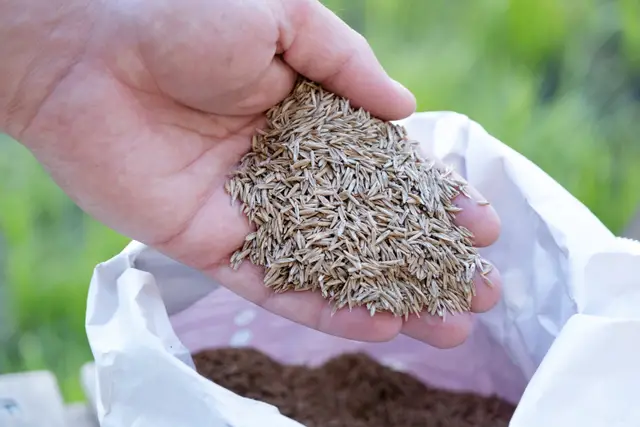
- Split the seed in two. Put half in the spreader and walk the lawn one way. Then spread the other half walking across your first lines.
- Get seed touching soil. Rake lightly, or cover with a thin quarter-inch layer of soil. The topsoil calculator gives the amount.
- Mulch bare ground. For a new lawn, Tennessee Extension suggests straw so that half to three quarters of the soil is covered; one 50 lb bale covers about 1,000 square feet.
- Keep it moist. Water lightly and often until the seedlings are up, then less often and deeper.
Questions people ask
How much grass seed do I need for 1,000 square feet?
It depends on the grass. For a new lawn: tall fescue 6 to 8 lb, Kentucky bluegrass 2 to 3 lb, perennial ryegrass and fine fescue 4 to 5 lb, common bermuda, zoysia and buffalo grass 1 to 2 lb, centipede a quarter pound. Big seeds need more pounds than small seeds to put down the same number of plants.
How much grass seed do I need per acre?
Multiply the rate per 1,000 square feet by 43.56. Tall fescue at 6 to 8 lb per 1,000 is 261 to 348 lb an acre; Kentucky bluegrass at 2 to 3 lb is 87 to 131 lb an acre.
Can I put down too much grass seed?
Yes. NC State Extension says not to assume more is better: seeding too heavily gives weak, thin stands that are more open to disease and heat stress, because the seedlings crowd each other for water, light and food.
How much seed for overseeding?
Less than for bare ground. University of Maryland Extension gives 4 lb per 1,000 sq ft for tall fescue, 1.5 lb for Kentucky bluegrass and 2.5 lb for fine fescue. Where no overseeding rate is published, Nebraska Extension's rule is to cut the full rate by up to half.
How long does grass seed take to come up?
University of Tennessee Extension lists about 6 to 14 days for the fescues and 14 to 21 days for Kentucky bluegrass. Bluegrass is slow, so keep watering after the ryegrass or fescue in a mix has already come up.
Why is there no seed rate for St. Augustine grass?
St. Augustine lawns are planted from sod, sprigs or plugs, not seed. University of Florida Extension lists those as its only establishment methods.
Next on your lawn
Sources
- Penn State Extension, Turfgrass Seed and Seed Mixtures
- University of Maryland Extension, Lawn establishment and overseeding rates
- Nebraska Extension, Spring Lawn Overseeding
- Purdue Extension, Establishing Turfgrass Areas From Seed (AY-3-W)
- North Carolina Department of Agriculture, Soil Fertility Note 5: Warm-season grasses
- University of Kentucky Turfgrass Science, Seeded Bermudagrass
- University of Georgia Extension, Zoysiagrass Lawns
- University of Missouri Extension, Establishment and Care of Zoysiagrass Lawns (G6706)
- Nebraska Extension, Establishing Buffalograss Turf in Nebraska (G1946)
- University of Florida IFAS Extension, Establishing Your Florida Lawn
- Iowa State University Extension, warm-season lawn grass care publication
- University of Tennessee Extension, Turfgrass Establishment: Seeding (W160-B)
- NC State Extension, lawn grass selection and seeding publication