How to get rid of clover in your lawn
Clover is a sign the grass is hungry. Feed the lawn to fix the cause, and use a broadleaf weed killer in fall if you want it gone faster.
Do not spray above 80 to 85 °F or on a dry, stressed lawn. Work out your fertilizer amount.
Expect a season or two. Work out your fertilizer amount.
Mow before it flowers if bees near bare feet are a worry.
Why clover moves in
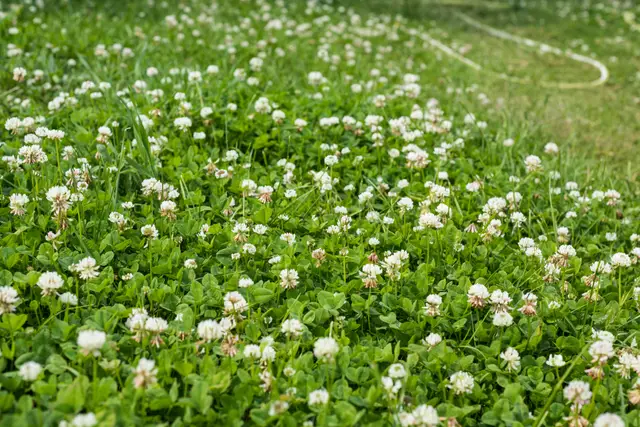
White clover is a legume. Bacteria on its roots turn nitrogen from the air into plant food, so it can grow where the soil has little. Grass cannot do that. In an underfed lawn the grass thins and the clover spreads into the gaps. Extension services in Iowa, Minnesota, Indiana, Pennsylvania, Tennessee and Colorado all describe clover as a sign of low nitrogen.
It is a perennial that creeps along the ground on stems that root as they go, and it tolerates close mowing, so mowing it off does nothing.
If the flowers are yellow and each of the three leaflets is heart-shaped, it is not clover but oxalis, which needs different weed killers.
Step 1: feed the lawn
Purdue's turf program calls increasing your annual nitrogen the best method for long-term control. Colorado State singles out fall nitrogen. Find the three numbers on your fertilizer bag and use the fertilizer calculator to get pounds for your lawn.
Step 2: spray in fall, if you want it gone sooner
| Question | Answer | Source |
|---|---|---|
| What to use | Broadleaf weed killer with 2,4-D, MCPP, dicamba or triclopyr | Iowa State |
| When | Mid-September to early November; mid-October is ideal | Iowa State, Purdue |
| Too hot | Above 80 to 85 °F: poorer control and risk of lawn burn | Purdue, Colorado State |
| Lawn condition | Well watered, not under stress | Purdue |
| Spring spraying | Works less well; clover often regrows | Penn State, Iowa State |
Read the label for your grass. Some broadleaf weed killers injure St. Augustine, centipede and other warm-season lawns. The label lists the grasses it is safe on and the rate. Keep spray off flower beds, vegetables and tree roots.
Step 3: close the gaps
Dead clover leaves bare soil, and bare soil grows weeds. Seed the patches in late summer or early fall for cool-season lawns. The grass seed calculator gives the amount. Most weed killers need a waiting period before seeding: the label states it.
Questions people ask
What kills clover but not grass?
A selective broadleaf weed killer. Iowa State Extension lists products containing 2,4-D, MCPP, dicamba or triclopyr as giving good control of white clover. They kill broadleaf plants and leave lawn grass alone when used as the label directs. Check that your grass type is on the label.
When is the best time to kill clover?
Fall. Iowa State says mid-September to early November works better than late spring or summer, and Purdue points to mid-October. Penn State notes clover often regrows after a spring spray.
Why is there so much clover in my lawn?
Usually because the lawn is short of nitrogen. Clover makes its own nitrogen, so it thrives where grass is starved. Minnesota Extension adds compacted soil and drought stress to the list of signals.
Will fertilizer get rid of clover?
It is the long-term fix. Purdue calls raising your yearly nitrogen the best method for lasting control, and Colorado State says regular feeding, especially in fall, reduces clover. It works slowly, by letting the grass crowd the clover out.
Can I spray clover in summer?
Better not. Colorado State says to avoid spraying above 85 °F and Purdue says above 80 °F: control is poorer and the lawn can be burned. Wait for fall.
Is clover bad for a lawn?
That is a matter of taste. It stays green in dry spells, feeds the soil with nitrogen and feeds bees. K-State notes it used to be a normal part of lawn seed mixes. The drawbacks are an uneven look, flowers that attract bees where children play barefoot, and patches that University of Maryland says can widen by a foot or more a year.
How do I get rid of clover without chemicals?
Feed the lawn, mow higher and water deeply so the grass thickens, and dig or pull small patches, taking the creeping stems with them. On a larger area this takes a season or two.
Next on your lawn
Sources
- Iowa State University Extension, How do I control white clover in my lawn?
- University of Minnesota Extension, Dutch white clover
- Purdue Turfgrass Science, White Clover in Golf Courses, Sports Turf, and Lawns
- Penn State Extension, Lawn and Turfgrass Weeds: White Clover
- Colorado State University Extension, White Clover Control in Lawns (PlantTalk 1542)
- University of Maryland Extension, Clover
- University of Tennessee Extension, White Clover (W267)
- K-State Turfgrass, White Clover