When to dethatch your lawn
Measure the thatch first. Under half an inch needs nothing. If it is thick, dethatch while the grass is growing strongly: early fall for cool-season lawns, late spring to midsummer for warm-season lawns.
Plan to overseed straight afterwards: dethatching thins the lawn.
These grasses build thatch faster than cool-season grasses, so check them every year.
Cut out a small wedge of lawn with a spade. Thatch is the brown, spongy layer between the green blades and the soil. Measure it with a ruler.
What thatch is, and how much is too much
Thatch is a layer of living and dead stems, roots and shoots that builds up on the soil surface. University of Idaho says up to half an inch is relatively harmless. Wisconsin Extension's line is an inch: at that depth it becomes unhealthy for the lawn. Grass clippings are not the cause; they break down quickly.
| Thatch | What to do |
|---|---|
| Under 1/2 inch | Nothing. This much cushions the lawn. |
| 1/2 to 1 inch | Core aerate yearly. It is gentler and thins thatch over time. |
| Over 1 inch | Dethatch with a vertical mower or power rake in the right season, then overseed. |
Dethatch or aerate?
K-State is frank about power raking: it works on thatch, but it is the most destructive method and the lawn may have to be reseeded. Core aeration is the first choice for moderate thatch because it leaves the turf in place. Keep full dethatching for a layer that is clearly too thick. See when to aerate.
How to dethatch
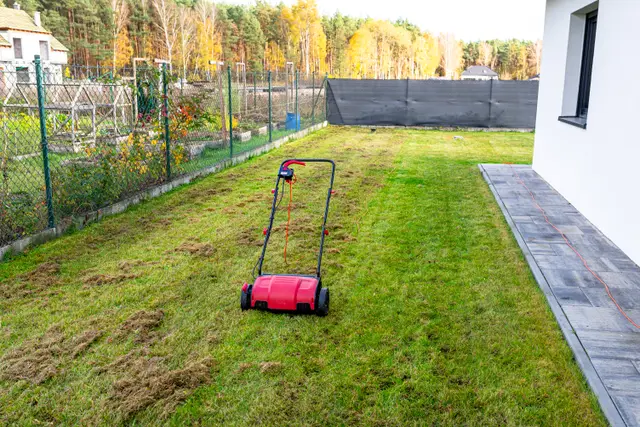
- Pick the season from the top of this page. The lawn must be growing strongly to recover.
- Mow a little lower than usual and work on soil that is moist, not wet.
- Run the machine in two directions. A rented vertical mower or power rake for a lawn; a dethatching rake for a small patch.
- Rake up and remove the debris. There will be a great deal of it.
- Overseed, feed and water. The grass seed calculator and fertilizer calculator give the amounts.
Questions people ask
How do I know if my lawn needs dethatching?
Cut out a wedge and measure the brown spongy layer above the soil. Under half an inch is fine. Over an inch needs removing. A lawn that feels bouncy underfoot is a hint to check.
What month should I dethatch?
September for cool-season lawns, or March to April. Late May through July for warm-season lawns.
Is dethatching bad for a lawn?
It is rough on it. K-State calls power raking the most destructive method and warns the lawn may need reseeding. That is why it is done only when thatch is thick, and only in the recovery season.
Should I dethatch or aerate?
Aerate for thatch between half an inch and an inch, or for compacted soil. Dethatch when the layer is over an inch.
Should I dethatch every year?
No. Most lawns never need it. Check the thickness each year and act only on what you measure.
Do grass clippings cause thatch?
No. Clippings are mostly water and decay quickly. Thatch is made of tougher stems and roots.
Sources
- University of Idaho Extension, lawn thatch and aeration bulletin (BUL 964)
- K-State Research and Extension, Aerating Your Lawn (MF2130)
- Utah State University Extension, Turfgrass Cultivation: Aerification